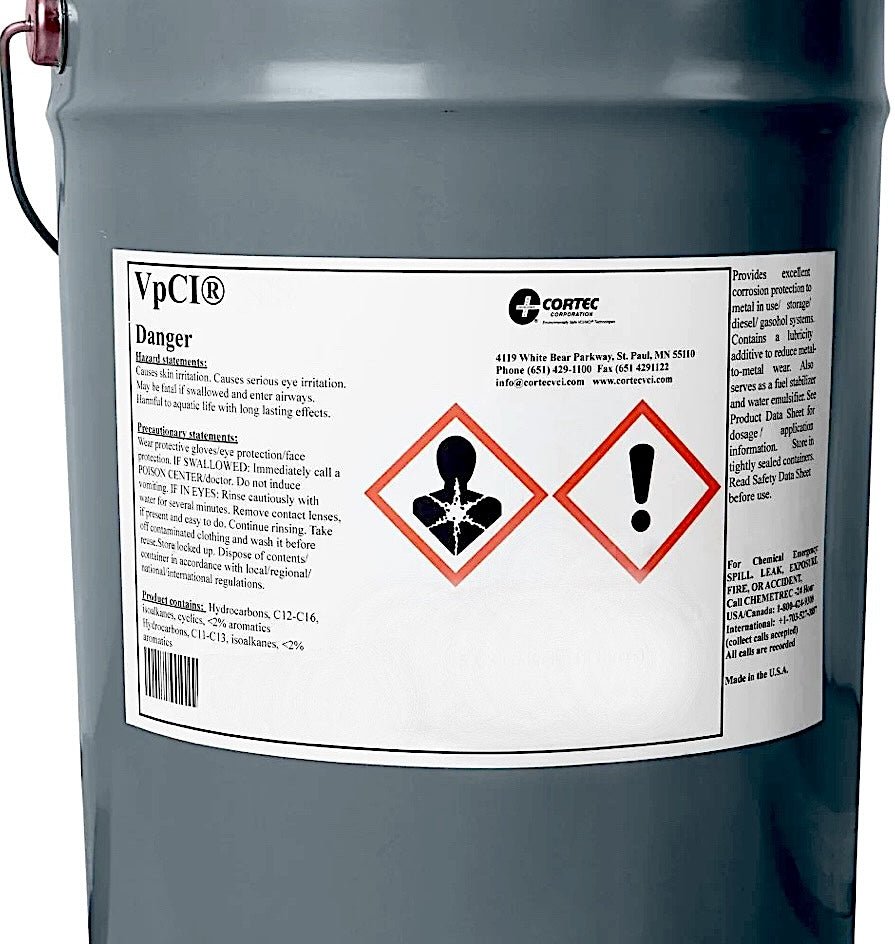
Cortec VpCI® 380 Railcar Coating
Cortec VpCI® 380 Railcar Coating
Stock TBD
Couldn't load pickup availability
- International Delivery
- Bulk Buying Discounts
- Best-in-Class Products
VpCI® 380 Railcar Coating is a one-of-a-kind, direct-to-metal (DTM) acrylic formulation. It has been enriched with fluoropolymer modification.
This coating is the perfect solution tailored specifically for the railcar industry.
Not only does this coating offer outstanding adhesion to various substrates, including ferrous and non-ferrous metals, but it also boasts exceptional compatibility with certain engineered plastics.
VpCI 380's superiority lies in its sophisticated blend of non toxic, organic corrosion inhibitors. With these components, it provides exceptional protection. It rivals even the most advanced primer and topcoat systems. With its fast-drying thixotropic characteristics, this coating exhibits a glossy finish, seamless flow, and remarkable levelling properties akin to alkyd coatings, all while maintaining excellent resistance to sagging.
Features
This innovative coating offers a rapid drying process, ensuring efficiency and convenience. Its high gloss finish further enhances its aesthetic appeal while providing optimal outdoor performance.
Safe and Non-flammable
The VpCI® 380 Railcar Coating is non-flammable, ensuring a secure application process. When fully dried, it becomes UV resistant. Thus, it is ideal for extended outdoor usage without any concerns about colour fading or degradation.
Versatile One-Coat System
This characteristic streamlines the application process, saving time and effort while still delivering top-notch results. Moreover, it provides exceptional protection for a wide range of metals, making it a reliable choice for various applications involving different metal types.
Adhesion Properties
The VpCI® 380 Railcar Coating boasts impressive adhesion properties, ensuring it adheres strongly to both ferrous and non-ferrous metals, guaranteeing a long-lasting and robust protective layer. Additionally, it exhibits remarkable adhesion even to some engineered plastics, making it a versatile option for various substrates.
Application
With an application thickness of 3-5 mil DFT, this coating serves both as a topcoat and a primer. For even better results, it can be used in combination with Cortec's VpCI 395 primer as a topcoat.
When applying VpCI 380, it's essential to ensure that the dew point is at least 5°F (2°C) lower than the air temperature to guarantee proper application. Achieving the right viscosity is crucial. You can power agitate the mixture to achieve it. Use a mixer with cylindrical shape or a hand-held one.
There are various application methods to choose from, such as spray, flow coat, brush, or dip, depending on the specific needs and preferences of the project.
We suggest using a fluid hose with a 3/8" (0.95 cm) I.D. for traditional spray application. The hose can have up to 50 feet (15.2 meters) in length. For best results, the pot must always have dual regulation. Always maintain the pot at the same elevation as the spray gun.
Alternatively, for airless application, a hose with a 3/8” (0.95 cm) I.D. is the minimum requirement, but a ¼” (0.64 cm) I.D. whip end section can be utilised for easier application. The suggested maximum length for the hose is 100 feet (30.5 m). To achieve the best results, it's advisable to use a tip with 0.3 to 0.4 cm width and a pressure range of 1200 to 1700 psi. For improved performance, consider using Teflon or nylon-type packings, available from the pump manufacturer.
It's worth noting that equipment similar to the ones described may also be suitable for application, providing a range of options for achieving effective results.
Packaging and Storage
This advanced coating is offered in various packaging options to suit your specific needs. Options include metal drums, pails, liquid totes, and bulk quantities. Liquid totes, bulk quantities and metal drums are in 55-gallon options while pails are only in 5 gallons.
To maintain the product's optimal performance, it is essential to store it in a controlled environment and prevent it from freezing. When stored appropriately, VpCI-380 boasts an impressive shelf life of one year, ensuring its reliability and effectiveness for an extended period.
Product Specifications (.PDF)
Frequently Asked Questions
• What exactly is Cortec VpCI-380 Railcar Coating, and what makes it stand out from typical coatings?
Cortec VpCI-380 Railcar Coating is a really unique, water-based acrylic formulation that's been enhanced with fluoropolymer technology, making it a direct-to-metal (DTM) solution. What truly sets it apart is its sophisticated blend of non-toxic, organic corrosion inhibitors, which means it offers protection that can genuinely compete with traditional primer and topcoat systems, all in a single product.
• How does this coating actively prevent corrosion on metal surfaces?
This coating employs a clever mechanism by forming a thin, mono-molecular protective barrier on the metal's surface using its specialized Vapor Phase Corrosion Inhibitors (VpCI). These inhibitors effectively shield the metal from aggressive ions and other corrosive elements, actively preventing rust and degradation from occurring. It's like an invisible, self-healing force field for your metal.
• Is the Cortec VpCI-380 specifically for railcars, or can it be used on other types of metal?
While it was indeed designed with the railcar industry in mind, the VpCI-380 is quite versatile! It shows excellent adhesion to a wide array of substrates, including various ferrous and non-ferrous metals like carbon steel, stainless steel, and even galvanized steel. Plus, it surprising adheres well to certain engineered plastics, broadening its potential applications beyond just railcars.
• What kind of finish can I expect after applying Cortec VpCI-380 Railcar Coating?
You can expect a really appealing high-gloss finish. This coating is thixotropic, meaning it has properties that allow for excellent flow and leveling, similar to alkyd coatings, which helps achieve that smooth, professional appearance while also resisting sag.
• Is the Cortec VpCI-380 coating considered environmentally friendly?
Yes, it's designed with environmental considerations in mind. Being a water-based formula, it generally has a lower VOC content compared to many solvent-based coatings. The non-toxic organic inhibitors also contribute to a more environmentally conscious approach to corrosion protection.
Relevant products you may want to consider:
• What are the primary types of metals that can be effectively protected by Cortec VpCI-380?
This coating is excellent for protecting a variety of metals, including carbon steel, stainless steel, and galvanized steel. It also demonstrates good adhesion to aluminum. For certain substrates like aluminum and galvanized steel, a wash primer such as VpCI-373 green might be recommended to ensure optimal adhesion, so a quick test area is always a good idea.
• Can Cortec VpCI-380 be used as both a primer and a topcoat?
Absolutely! When applied at a dry film thickness of 3-5 mils, it functions effectively as both a primer and a topcoat. This "one-coat system" capability can really streamline your application process, saving time and effort.
• Are there any specific conditions I need to consider before applying this coating, like temperature or humidity?
Yes, for the best results, it's crucial to ensure that the dew point is at least 5°F (or 2°C) lower than the air temperature during application. This helps with proper curing and adhesion.
• What are the common methods for applying Cortec VpCI-380 Railcar Coating?
You've got a few flexible options for application! It can be applied using spray methods (both conventional and airless), flow coating, brushing, or even dipping, depending on the specific project and equipment you have available.
• When using a spray application method, what kind of equipment setup is recommended for optimal results?
For conventional spray, a fluid hose with a 3/8" (0.95 cm) inner diameter is suggested, with a maximum length of 50 feet (15.2 meters). It's also important that the pot maintains dual regulation and stays at the same elevation as the spray gun. If you're going with airless application, a 3/8” (0.95 cm) inner diameter hose is the minimum, but a 1/4” (0.64 cm) whip end section can make it easier to handle. A maximum hose length of 100 feet (30.5 meters) is recommended, with a tip width of 0.3 to 0.4 cm and pressure between 1200 and 1700 psi. Teflon or nylon-type packings from the pump manufacturer are also a good idea for improved performance.
Relevant products you may want to consider:
• Is it necessary to prepare the surface before applying Cortec VpCI-380? If so, what does that involve?
Yes, proper surface preparation is key for any coating to perform its best. You'll want to ensure the substrate is free from grease, oil, dirt, and fingerprints. For bare metals, a NACE ~3 / SSPC-SP6 standard is recommended. If applying over already painted surfaces, at least an SSPC-SP1 clean is advised. Always consult with technical services or test adhesion in a small area beforehand!
• Can this coating be used in conjunction with other primers, or is it always a standalone system?
While it's designed to be a one-coat system functioning as both primer and topcoat, for even better results, it can certainly be used as a topcoat over Cortec's VpCI-395 primer. This offers added flexibility for different project requirements.
• How should I prepare the Cortec VpCI-380 coating before application?
Before you start, make sure to power agitate the mixture thoroughly to achieve a uniform consistency. You can use a "squirrel cage" type mixer, a hand-held drill mixer, or any equivalent method to get it ready.
• Does the VpCI-380 coating resist sagging during application?
Yes, it does! The thixotropic properties of VpCI-380 contribute to its good resistance to sag, which is really helpful when applying it to vertical surfaces like the sides of railcars, ensuring an even and consistent coat.
• What are the ideal temperature conditions for storing the Cortec VpCI-380 coating?
To ensure the product maintains its optimal performance and shelf life, it's essential to store it in a controlled environment, ideally indoors and out of direct sunlight, with temperatures between 40-100°F (4-38°C). Preventing it from freezing is also crucial.
Relevant products you may want to consider:
• How quickly does Cortec VpCI-380 dry to the touch?
You'll be pleased to hear that it's a fast-drying coating! It typically dries to the touch in about 30 minutes when applied at 3 mils (75 microns) DFT and at 77°F (25°C).
• What is the full cure time for Cortec VpCI-380 Railcar Coating?
While it dries quickly to the touch, the coating takes approximately 7 days to fully cure at 77°F (25°C) and 55% relative humidity to achieve its maximum hardness and protective properties.
• How durable is this coating when exposed to outdoor elements, particularly sunlight?
It's exceptionally durable for outdoor performance! The VpCI-380 is UV resistant once dried, which means it resists cracking or chipping even after prolonged exposure to sunlight, maintaining its integrity and appearance over time.
• Can this coating withstand harsh industrial environments?
Absolutely. Its hardness and moisture resistance properties make it an excellent choice for air-dry or force-dry industrial finishes, providing robust protection in demanding environments. It's been shown to pass over 1,000 hours in ASTM B117 salt spray and ASTM D1748 humidity conditions.
• Does Cortec VpCI-380 offer good resistance to moisture?
Yes, it exhibits good moisture resistance, which is a critical characteristic for a coating designed to protect assets exposed to outdoor weather and varying humidity levels.
Relevant products you may want to consider:
• What is the expected shelf life of Cortec VpCI-380 Railcar Coating?
When stored correctly in its original packaging, indoors and away from direct sunlight, the VpCI-380 boasts an impressive shelf life of one year, ensuring its reliability and effectiveness for an extended period.
• What are the main benefits of using Cortec VpCI-380 compared to other conventional corrosion inhibitors?
One of the biggest advantages is its innovative VpCI technology, which creates a self-healing, mono-molecular protective layer. Unlike traditional coatings that might rely on sacrificial metals and leave gaps where corrosion can start, VpCI-380 forms a tight bonding structure, effectively preventing corrosion from taking hold. Plus, it's water-based and non-flammable, offering a safer alternative.
• Does this coating offer protection for multiple types of metals simultaneously?
Yes, it's designed to provide multi-metal protection, which is incredibly useful for applications where different types of metals might be in close proximity or part of the same assembly, simplifying your corrosion protection strategy.
• Is the VpCI-380 coating non-flammable?
Yes, this is a significant safety benefit – Cortec VpCI-380 Railcar Coating is non-flammable, making it a safer option for both application and storage compared to many solvent-based alternatives.
• How does the VpCI-380 contribute to reduced maintenance costs for railcars or other coated assets?
By providing superior, long-lasting corrosion protection, the VpCI-380 significantly extends the lifespan of railcars and other metal equipment. This reduction in corrosion-related damage directly translates to fewer repairs, less frequent recoating, and ultimately, lower maintenance costs over time.
Relevant products you may want to consider:
• Can the VpCI-380 be tinted to match specific colors?
Yes, it can be tinted to most custom colors, offering flexibility for aesthetic requirements or brand matching.
• What is the typical dry film thickness (DFT) recommended for Cortec VpCI-380?
The recommended dry film thickness per coat is typically between 3.0 and 5.0 mils (75-125 microns). This range ensures effective protection and performance.
• What are the standard packaging options available for Cortec VpCI-380 Railcar Coating?
The product is available in various convenient packaging sizes, including 5-gallon (19-liter) pails, 55-gallon (208-liter) metal drums, liquid totes, and also in bulk quantities to suit different project scales.
• What precautions should be taken when handling Cortec VpCI-380?
Although it's water-based and generally safer, it's always wise to follow good industrial hygiene practices. Ensure good ventilation in the workplace, wear appropriate personal protective equipment like gloves and eye protection, and wash hands thoroughly after use. It's also important not to let the product enter sewers or surface/ground water.
• How should I clean my tools and equipment after using Cortec VpCI-380?
For easy cleanup, tools and equipment should be cleaned immediately after use with water while the coating is still wet. If the coating has dried, stronger solvents like Butyl Cellusolve or MEK can be used, always following the manufacturer's safety recommendations for those solvents.